The summer cabin by the river
Out Stealing HorsesThe summer cabin by the river served two lives at once: it was a derelict rural property that Trond’s father patiently restored, and a carefully maintained cover for the final link of a wartime courier route to Sweden. Trond’s family knew nothing of this second life until Franz’s account connected the cabin’s repairs, its river crossing, and the father who had seemed simply to come and go.
Location and Condition
The cabin stood on the east bank of the river, within a smallholding that had been vacant since a foreclosure before the war. The property had belonged to Barkald, who had bought it cheaply and had little use for it. It had been empty for four years when Franz showed it to Trond’s father. The cow byre had already collapsed, and there was no herd to replace it. The cabin’s isolation made it useful: the nearest bridge was a twenty-minute walk away, and beyond the farmsteads behind it there were no other buildings until well past the Swedish border.
This remoteness was not simply an absence of neighbors. It placed the cabin beside a route that could be crossed on foot, while leaving Trond’s father room to appear as someone occupied with ordinary rural work. The river and the long walk to the bridge shaped the location’s practical value; the empty smallholding gave him a reason to be there without drawing attention to the purposes of his visits.
Repair as Cover and Routine
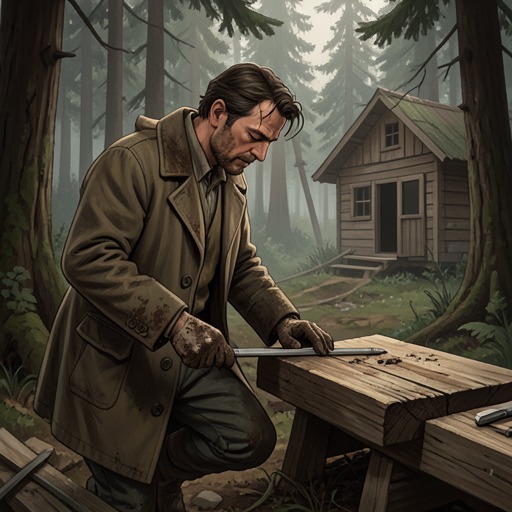
Trond’s father took to the place and set about making it usable. He cut the grass, cleared and burned the remains of the byre, repaired the roof and its tiles, cleaned scrub from the riverbank, and renewed the house’s gable boards. He replaced broken windowpanes, mended the stove with oven-sealer, swept the chimney, and made two chairs. These were not decorative improvements: each gave him legitimate tasks that needed doing, and together they made the cabin look like a smallholding being gradually brought back into order.
The work also allowed his stays to lengthen without requiring an obvious explanation. He had initially intended to remain only long enough for people to become accustomed to seeing him across the river, working on the roof, tending the yard, or sitting by the water. After returning from trips to Sweden, however, he would find another repair to make or another patch of grass to cut. In this way, over a couple of years, he created an alternative life at the cabin while his family in Oslo knew nothing of it.
The contrast with his home life was substantial. In Oslo, the family rented three rooms and a kitchen on the second floor of a three-storey house near Ljan, with a view of the Oslofjord and Bunnefjord. The cabin gave Trond’s father the time and freedom to do practical work that he could not find there. The repairs were useful in themselves, but they also formed a visible pattern that made his presence in the village by the river seem ordinary.
The Resistance Route and the Guarded Bridge
The cabin became a base for Trond’s father’s journeys across to Sweden with papers and, at times, films for the Norwegian Resistance. He used it as cover for the last link in the courier line, known as The traffic. He was often away from his Oslo family for weeks or months, and even when he returned home, Trond found him changed in ways that were hard to define. The family knew that he travelled; they did not know where he went or that he had built a second, sustained life around the cabin.
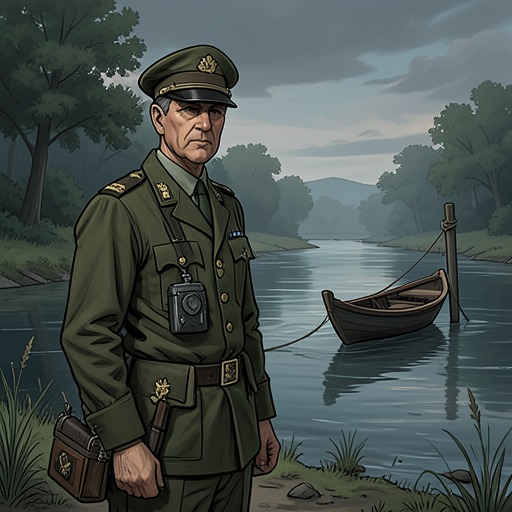
The route could not avoid the bridge. A German patrol was stationed at the farm nearest the church and shop, and a guard was often posted on the gravel approach. When Trond’s father crossed, he made conversation with the guard rather than treating him as invisible. Speaking German, he learned about the young soldiers’ homes and families, their interests, and what they missed. He spoke to them considerately, unlike many people around them, and he and a guard might share cigarettes before Trond’s father continued over the bridge toward the cabin with his shabby bag.
That familiarity did not remove the danger. The guard carried a submachine gun, and Trond’s father understood that an unexpected movement could make him a target: if he suddenly ran, the soldier would likely order him to stop and could fire if he did not. The calm exchanges therefore belonged to the cover as much as the repairs did. The cabin was reached through an ordinary-looking routine that depended on managing the attention of those who controlled the crossing.
Refuge and Escape
The cabin also became a place of refuge during an escape to Sweden. When soldiers arrived, Trond’s father and Jon’s mother gathered the most important belongings and the documents he had hidden there. They saw cars crossing the field from the road and soldiers running down toward the river. They packed what they needed into a suited man’s bag, wrapped it in a sheet, and climbed out through the back window. With Trond’s father’s long white underwear worn over their clothes, they fled hand in hand, more or less, toward Sweden.
In that moment, the cabin’s domestic features became part of the escape: a window provided a way out, hidden documents could be retrieved, and the bag used for ordinary supplies could carry what mattered. The place that had been made to seem like a neglected home had also been prepared, through years of discreet use, to support the dangerous work of crossing the border.
What Trond Learns
Franz’s account made the cabin’s history new to Trond. He had known that his father disappeared and returned, but not that he had spent so much time in the village by the river, or that the cabin had been his base for years. Trond wondered why his father had never told him, and why Jon, Jon’s mother, Barkald, or people at the shop had not mentioned his father’s earlier presence nearby. He did not ask Franz to explain the silence.
After that morning, Trond could no longer see the surrounding valley as he had before. The forest, fields, and river seemed altered, as did his understanding of his father. The cabin had held a life that the family was not meant to know about; learning of it made his father at once more comprehensible and more distant. Trond also recognized that Franz, rather than his father, had opened this part of the past to him, leaving him unsure whether he had the right—or the wish—to enter further.